

16 Best Family Strategy Games for Kids and Adults
This post may contain affiliate links, which means I make a small commission at no extra cost to you.
See my full disclosure here.
16 Best Family Strategy Games for Kids and Adults
If you’re looking for the best family strategy games, you’ve come to the right place! These are 16 of our family’s favorite games for exercising our brains, enjoying a little friendly competition, and spending time together without screens.
Over the years, our three boys have spent countless hours playing board games together and with us. From quick two-player challenges to longer games that require planning, negotiating, and thinking several moves ahead, strategy games have always been a big hit in our home.
One thing I especially appreciate about strategy games is that they grow with your kids. A game that’s challenging for a seven-year-old can still be enjoyable for a teenager or adult. And as kids grow, their strategies grow right along with them.
I’ve also found that the right games can help bridge the age gap between siblings. When our youngest was still learning to read, his older brothers weren’t particularly interested in playing little-kid games. But certain strategy games gave all three boys something they could enjoy together.
Every game on this list is one we own and have enjoyed as a family. I’ve divided them into two-player games and games for larger groups, with a few favorites that work equally well for either.
A quick note about ages: I’ve arranged the games loosely from youngest to oldest based on the recommended ages, but remember that age recommendations are always just guidelines! We’ve found that many games work well for younger children, especially when they’re playing alongside older siblings or parents. Don’t be afraid to introduce a game earlier than the recommended age if you think your child is ready.
Whether you’re looking for something to play with one child, a new addition to family game night, or a gift that will be enjoyed for years, I hope you’ll find a few new favorites!
Best Two-Player Strategy Games
Sometimes you just need a good game for two. These strategy games are perfect for siblings, one-on-one time with a parent, or anyone who enjoys a little head-to-head competition.
Several of these games can also accommodate more than two players, making them versatile additions to your family’s game collection.

1. Mancala
- Ages: 6+
- Players: 2
- Playing time: 10–20 minutes
- Reading required: No
Mancala is a classic strategy game that deserves a place in any family game collection.
Players take turns moving stones around a board with small cups, trying to collect the most stones in their own scoring area.
It’s an excellent introduction to strategic thinking for younger children, while offering plenty of opportunities for older players to plan ahead and outmaneuver an opponent.
I especially appreciate games like Mancala that require no reading, have very few pieces, and can be played in a relatively short amount of time.

2. Chess
- Ages: 6+ with guidance
- Players: 2
- Playing time: 20–60+ minutes
- Reading required: No
Chess is the ultimate classic strategy game, and for good reason! With no element of luck involved, every move counts. Players must anticipate their opponent’s plans, protect their pieces, and think several steps ahead.
I love that chess is a game kids can begin learning at a fairly young age and continue mastering for the rest of their lives.
Our favorite chess sets: We own and enjoy two different styles. The first is a traditional wooden folding chess set, with a board that closes to store all the pieces inside. I love that everything stays together when we’re not playing. If you’re shopping for a chess set, I highly recommend this style.
We also have a Take ‘N’ Play Anywhere magnetic chess set that we’ve used for years. It’s a miniature chessboard that folds into a metal case, with flat magnetic pieces that store inside. It’s a fantastic option for traveling, waiting rooms, or anytime you want an easy way to play chess on the go.
Our exact miniature set is no longer readily available, but I’ve linked to similar options.
Chess sets we recommend:
- Wooden folding chess set with storage
- Mini magnetic travel chess set, option 1
- Mini magnetic travel chess set, option 2

3. Battleship
- Ages: 7+
- Players: 2
- Playing time: 20–30 minutes
- Reading required: No
Battleship is a classic for a reason!
Players secretly arrange their ships on a grid, then take turns guessing coordinates to locate and sink their opponent’s fleet.
While luck certainly plays a role, players can use logic and deduction to narrow down possible locations and make smarter guesses.
Battleship is a great way to practice coordinates, critical thinking, and problem-solving without making it feel like schoolwork.

4. Labyrinth
- Ages: 7+
- Players: 2–4
- Playing time: 20–30 minutes
- Reading required: No
Labyrinth holds a special place in my heart because it’s one I played over and over with my youngest son.
The object is to navigate a maze, collecting treasures along the way. But there’s a twist: the maze itself keeps changing!
On each turn, players slide a tile into the board, shifting the pathways and opening or blocking routes to different treasures.
Labyrinth is perfect for younger kids who can’t read yet, but it’s still challenging and engaging enough for older elementary students.
I love games like this because they give younger children a chance to participate in a real strategy game without needing someone to read cards or instructions for them.
And because the board changes with every turn, no two games play out quite the same way.

5. Cathedral
- Ages: 8+
- Players: 2
- Playing time: 20–30 minutes
- Reading required: No
Cathedral is one of those games that’s much harder than it looks!
This gorgeous wooden strategy game features a medieval walled city and a collection of buildings in various shapes and sizes. Players take turns placing buildings inside the city walls, trying to claim as much space as possible while limiting their opponent’s options.
The challenge comes from figuring out how to fit your pieces together while preventing your opponent from doing the same.
All three of my boys enjoy Cathedral. It’s a beautifully made game that feels more like a keepsake than a typical board game.
And while the rules are quite straightforward, the strategic possibilities make it surprisingly challenging.

6. Stratego
- Ages: 8+
- Players: 2
- Playing time: 30–45 minutes
- Reading required: No
Stratego is a longtime favorite with my boys.
Each player commands an army of pieces with different ranks and abilities, strategically arranging them on the board before the game begins. The goal is to capture your opponent’s flag while protecting your own.
Because the opposing pieces remain hidden until they’re challenged, players have to combine logic, memory, and a little bluffing to succeed.
It’s a fun combination of planning, deduction, and military strategy that keeps players guessing until the end.
For kids who enjoy competition and outsmarting an opponent, Stratego is an excellent choice.

7. Quoridor
- Ages: 8+
- Players: 2–4
- Playing time: 15–20 minutes
- Reading required: No
Don’t let the straightforward appearance of Quoridor fool you! This clever game requires plenty of strategic thinking.
The objective is to move your pawn to the opposite side of the board before your opponent does. Sounds easy, right? Except that players can place walls to block each other’s progress, forcing opponents to rethink their routes.
Quoridor is easy to learn, quick to play, and challenging enough to keep older kids and adults interested.
Our favorite versions: We own the full size, but the Quoridor Mini is perfect for travel, waiting rooms, and other times when you need a portable activity. It’s a great little game to keep handy for screen-free entertainment on the go.

8. Quixo
- Ages: 8+
- Players: 2 or 4
- Playing time: 15 minutes
- Reading required: No
Think tic-tac-toe, but with a strategic twist!
In Quixo, players work to arrange five cubes in a row by sliding pieces around the board. The catch is that every move changes the arrangement of the cubes, often disrupting your opponent’s plans in the process.
The rules are easy to understand, but winning requires careful planning and the ability to anticipate your opponent’s next move. Plus, the sturdy wooden cubes are beautifully made and have a satisfying weight and feel to them.
This is another excellent choice for families who appreciate games that are quick to learn but take real thought to master.

9. Quarto
- Ages: 8+
- Players: 2
- Playing time: 15–20 minutes
- Reading required: No
Quarto is a clever wooden strategy game that’s easy to learn but surprisingly challenging! The goal is to line up four pieces that share a characteristic, such as height, color, or shape. The twist? Your opponent chooses which piece you play!
We own the Mini version, which is compact and perfect for travel. Another great option for quick, screen-free fun that challenges kids and adults alike. We also love the beautiful, well-made wooden board and pieces.

10. Memoir ’44
- Ages: 8+
- Players: 2
- Playing time: 30–60 minutes
- Reading required: Some
For kids who love history, military strategy, or both, Memoir ’44 is hard to beat.
This World War II strategy game recreates historical battles using miniature soldiers, tanks, artillery, and terrain pieces. Players command opposing armies, making tactical decisions to accomplish objectives and defeat their opponent.
My oldest and youngest sons especially LOVE this game. They’ve spent so much time playing it that they’ve added expansions to introduce new battles and challenges.
I love the way Memoir ’44 combines strategic thinking with history. Instead of just reading about military campaigns, players get to think through the decisions involved in actual battles.
Look for: Memoir ’44 expansions, which add new scenarios, armies, and other elements to the original game.
Best Strategy Games for Family Game Night
These games are especially well suited to family game night, when three or more people want to play together.
Some are quick and straightforward, while others involve more complicated rules and longer playing times.

11. Qwirkle
- Ages: 6+
- Players: 2–4
- Playing time: 30–45 minutes
- Reading required: No
Qwirkle is one of my favorite recommendations for families with children of different ages.
When my youngest was still learning to read, his older brothers had reached the stage where they weren’t particularly interested in playing little-kid games. Qwirkle was a fantastic solution.
Players take turns arranging wooden tiles according to their colors and shapes, scoring points as they build rows and columns. There’s no reading involved, and the rules are uncomplicated enough for young children to understand. But the strategy involved makes the game genuinely challenging for older kids and adults.
We played Qwirkle quite a bit during those years, and we still pull it out occasionally, even though our youngest learned to read long ago.
It’s uncomplicated but surprisingly strategic, which is exactly what makes it such a great family game. If you’re looking for a game that younger children can play without leaving older siblings bored, I highly recommend Qwirkle.

12. Rook
- Ages: 8+
- Players: 4 for traditional partnership play
- Playing time: 30–60 minutes
- Reading required: No
Rook is a classic trick-taking card game that combines teamwork, planning, and a healthy dose of competition.
In the traditional four-player version, players form partnerships and work together to win tricks and collect points. The challenge is figuring out which cards to play, which to save, and how to cooperate with your partner without revealing your hand.
If your family enjoys card games, Rook is a great one to learn. And because it requires only a deck of cards, it’s easy to take along when traveling.

13. Azul
- Ages: 8+
- Players: 2–4
- Playing time: 30–45 minutes
- Reading required: No
Azul is another beautiful strategy game that’s easy to learn but offers plenty of depth.
Players take turns selecting colorful tiles and arranging them into patterns on their individual boards, earning points for carefully planned placements. The challenge is deciding which tiles to take while anticipating what your opponents might need. A move that benefits you could also help someone else, so planning ahead is essential.
Azul combines pattern recognition, spatial reasoning, and strategy in a game that’s enjoyable for kids and adults alike. I also appreciate that there’s no reading involved, making it accessible to younger players who are ready for a more challenging game.

14. Bohnanza
- Ages: 10+
- Players: 2–7, depending on edition
- Playing time: 30–45 minutes
- Reading required: Minimal
Bohnanza is a quirky little card game that was introduced to our family by a friend, and it has become a favorite!
The premise is unusual: you’re a bean farmer trying to grow, trade, and harvest different varieties of beans to earn the most coins. But there’s a catch. You have to play the cards in your hand in order, which means trading becomes a big part of the strategy.
The result is a lively game full of negotiations, unexpected trades, and plenty of interaction between players.
Bohnanza is a great choice for families who enjoy strategy games but don’t want to spend the entire evening sitting quietly and thinking through their next move.

15. Catan
- Ages: 10+
- Players: 2–4 in our family; standard rules designed for 3–4
- Playing time: 60–90 minutes
- Reading required: Some
Catan is probably one of the best-known modern strategy games, and for good reason!
Players settle an island by gathering resources, building roads and settlements, trading with other players, and competing to earn victory points. The board changes from game to game, and success requires a combination of strategic planning, negotiation, and adapting to changing circumstances.
My boys love Catan. They regularly play with just two people, all three brothers enjoy playing together, and we’ve also pulled it out for many family game nights over the years.
I especially appreciate the way this game encourages players to negotiate and interact with one another. You can’t just focus on your own next move. You have to pay attention to what everyone else is doing, too.
If you’re looking for a family strategy game with plenty of replay value, Catan is an excellent choice.
Look for: The 5–6 Player Extension for larger groups, or one of the many Catan expansions for additional challenges.
16. Dominion
- Ages: 13+ (publisher recommendation)
- Players: 2–4
- Playing time: About 30 minutes
- Reading required: Yes
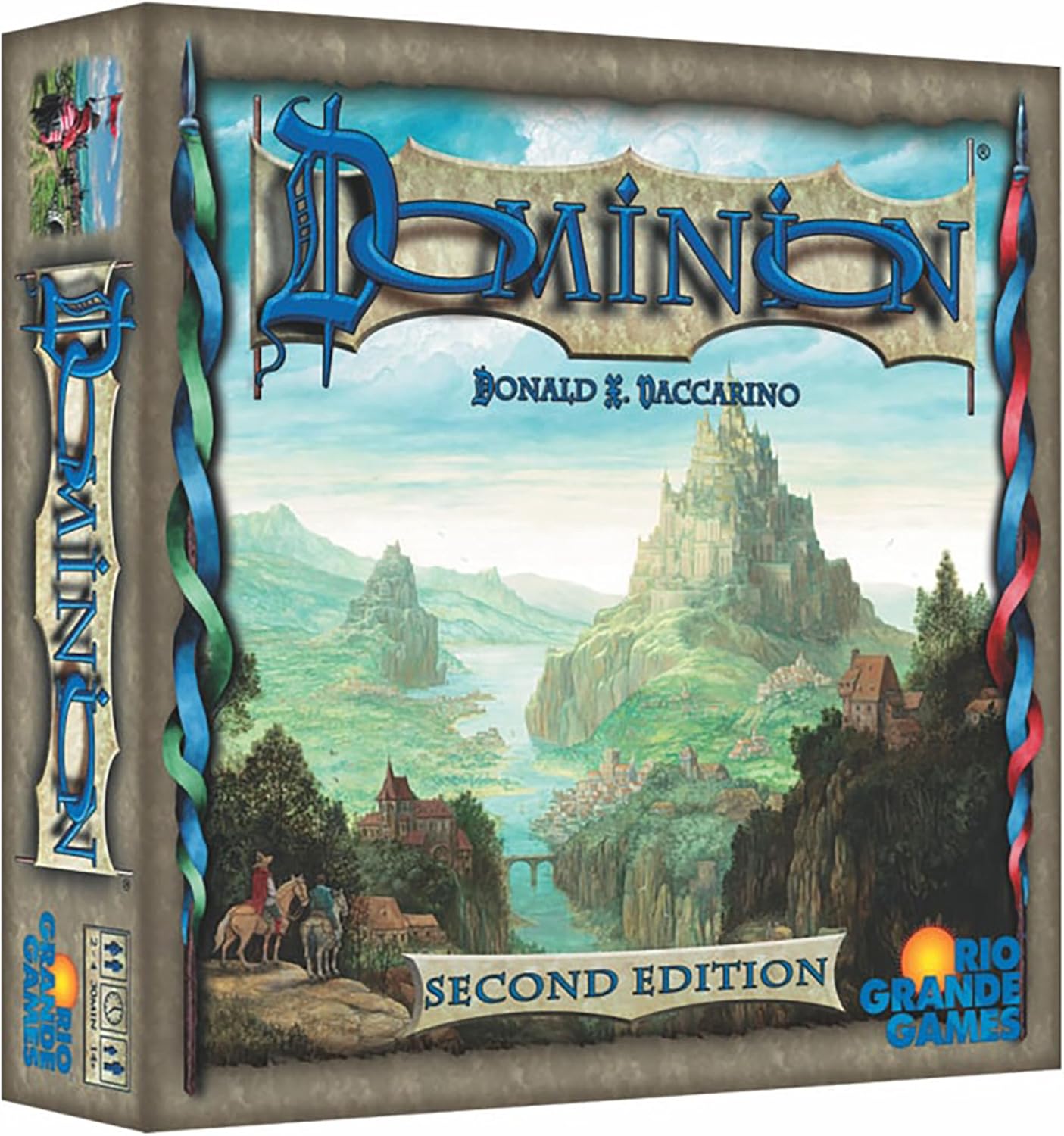
Dominion is a deck-building strategy game in which players begin with a small collection of cards and gradually build their own increasingly powerful deck.
As the game progresses, players purchase action cards, treasures, and victory points, developing a strategy for building the most successful kingdom.
What makes Dominion especially interesting is that the available cards can change from game to game. Just when you think you’ve figured out a winning strategy, a different combination of cards presents a new challenge.
This is a great option for older kids and teens who enjoy more complex strategy games.
Look for: Dominion expansions that add new cards and strategic possibilities once you’ve mastered the original game.
How to Choose the Best Family Strategy Games
With so many great options, how do you choose?
I recommend considering the ages of your children, how many people typically play together, and how much time you want to spend on a game.
For younger children and non-readers: Qwirkle, Labyrinth, Mancala, and Quoridor are excellent places to start. All four allow children to practice thinking strategically without needing to read.
For siblings who enjoy head-to-head competition: Chess, Stratego, Battleship, Cathedral, and Memoir ’44 provide plenty of opportunities to outsmart an opponent.
For families with older kids and teens: Catan, Dominion, Azul, and Bohnanza offer more complicated decisions and plenty of replay value.
For travel or waiting rooms: Quoridor Mini is a particular favorite of ours, and a folding magnetic chess set is another handy option.
Don’t feel limited by the manufacturer’s age recommendations, either. Some kids are ready for more challenging games at younger ages, especially when they have older siblings to teach them.
Make Family Game Night a Habit
One of the things I love most about family games is that they provide a natural opportunity to spend time together.
You don’t need an elaborate plan or an expensive outing. Sometimes all it takes is clearing off the table and pulling out a favorite game.
Over the years, I’ve watched my boys challenge each other, teach each other, and spend hours together playing games. They’ve learned to think ahead, handle disappointment, negotiate, persevere, and occasionally accept defeat at the hands of a younger brother.
And they’ve had a whole lot of fun in the process.
In a world that offers endless screen-based entertainment, I love having a collection of games that my boys genuinely enjoy playing, with each other and with us.
I hope this list of our favorite family strategy games helps you discover a few new options for your own family!
Looking for more family games? Don’t miss these other favorites:
What are your family’s favorite strategy games? I’d love to hear your recommendations in the comments!


Sign up NOW for my best tips delivered weekly to your inbox!
You’ll also get instant access to my library of free ebooks and resources.
You might also like...



Leave a Comment